
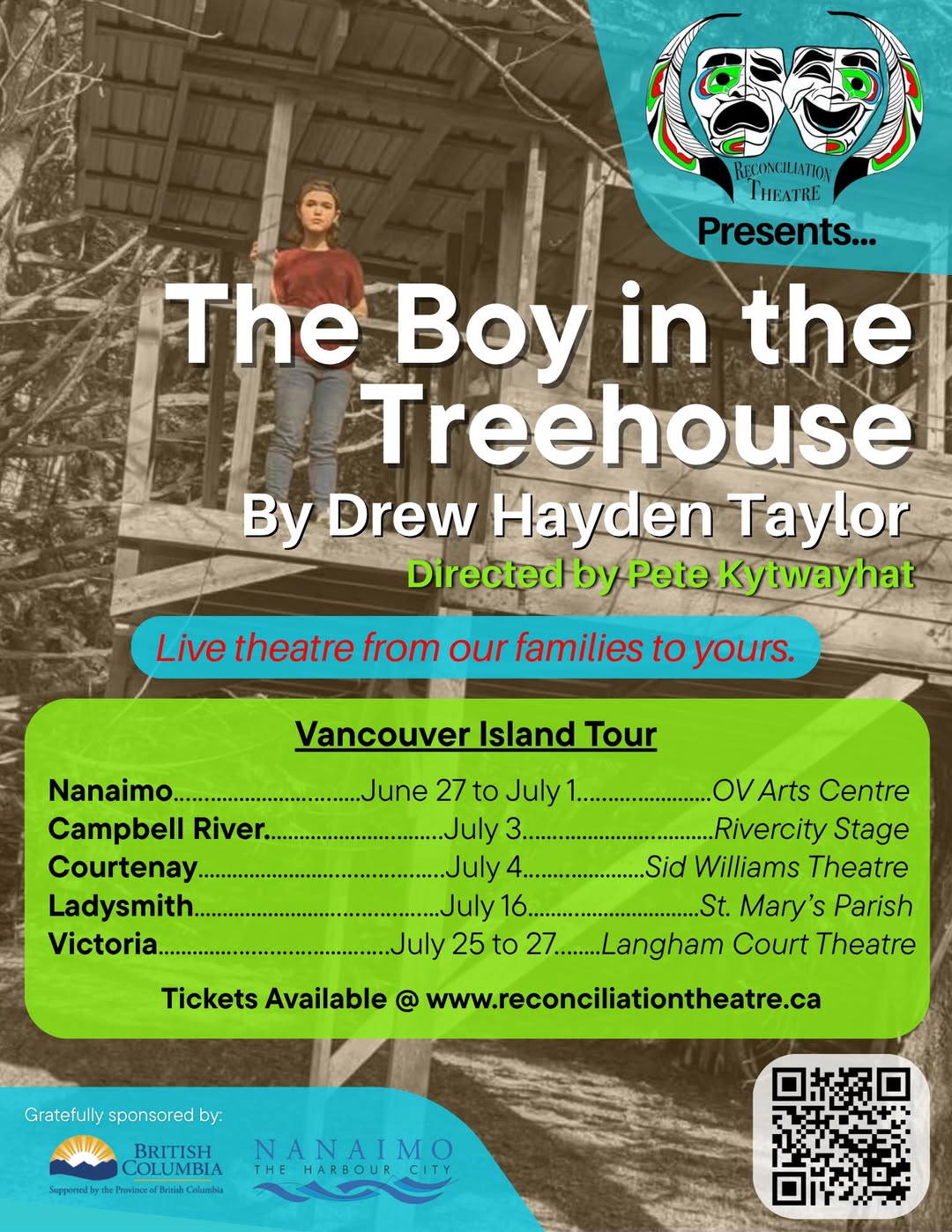
Reconciliation Theatre will be sharing the stage with a short (about 30 mins) Indigenous Production out of Victoria titled Gold. They will perform before The Boy in the Treehouse on Friday, July 25 and Sunday, July 27.
Written by Drew Hayden Taylor
Directed by Pete Kytwayhat
The Boy in the Treehouse is an entertaining and moving story of self-discovery that delves into the complexities of growing up Indigenous in a multicultural world. Simon finds refuge in his treehouse as he grapples with questions about who he is and where he belongs. Through laughter, heart, and a touch of magic, “The Boy in the Treehouse” offers a poignant yet uplifting story that resonates with the entire family.
Simon, a Canadian kid with an Anishinaabe mom and a European dad, seeks solace in his treehouse as he navigates questions of identity, family, and cultural heritage. Drew Hayden Taylor’s signature wit and warmth make this a must-see for all ages—a story about roots, resilience, and the joy of growing up.
Directed by Cree performance artist and filmmaker Pete Kytwayhat, this production blends heartfelt storytelling with universal themes. “This play speaks to anyone who’s ever wondered who they are and where they fit,” says Kytwayhat. “It’s a celebration of family, culture, and the messy, beautiful journey of growing up.” Featuring a cast of five, accompanied by the spirited fiddle of Metis musician Kenneth Chalifoux, the show weaves music and memory into a truly immersive and unforgettable experience.
Written by Katłı̨̀ą
Directed by Diana Budiachenko
This interpretive theatrical production, performed through contemporary dance in evocative pantomime, is loosely based on a true story about the infamous Giant Mine in the Northwest Territories, Canada, on Dënéndeh lands of the Dene. Dene means flowing from earth and Dënéndeh means land of the people in the Dene language.
The Giant Mine has been an unwelcome legacy impacting the traditional livelihood of Yellowknife Dene First Nation members in the Northwest Territories, Canada. Giant mine was established in the early 1940s and was abandoned in the late 1990s.
Viable reports are pointing to the deaths of Yellowknife Dene First Nation children in their home community, that traced directly to arsenic poisoning, and as a result, a small financial compensation was paid out by the mining company to the families that lost loved ones. A study done by the Indian Brotherhood in the 1970s showed that ninety per cent of Indigenous people living in proximity to Giant Mine had high levels of arsenic in their systems when tested with hair samples, yet mine production continued. Inorganic arsenic toxicity levels in the abandoned and surrounding vicinity of Giant Mine continue to exceed safe levels.
There is no known solution on how to effectively contain the 237,000 tons of deadly arsenic underneath the earth from seeping into northern waterways and killing everything in its path, essentially affecting the entire world.
The Giant Mine truly stands up to its name.
Box Office
250.384.2142
boxoffice@langhamtheatre.ca
General Manager
250.384.2142
gm@langhamtheatre.ca
Costume Loft
250.384.2025
costumeloft@langhamtheatre.ca
Mailing Address
805 Langham Court
Victoria, BC V8V 4J3 Canada
Google Maps »


© Langham Court Theatre Privacy Policy